Educational information, not medical advice. Written from the sources cited and reviewed before publishing. How we work.
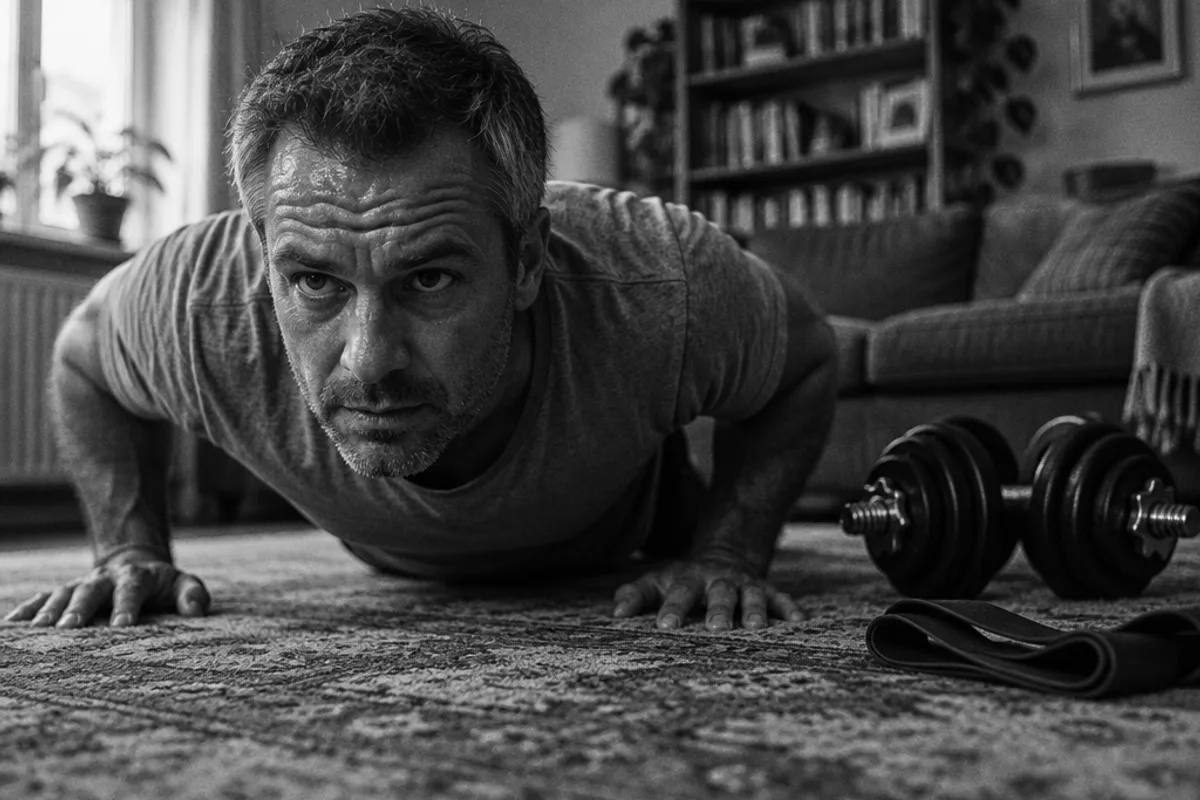
You have probably heard that a full body workout at home for men is a stopgap, something you do until you can get back to a real gym with a barbell. We think that is wrong for most men over 40. In the trials, light loads built as much muscle as heavy ones when the sets were taken to the point where no more reps were possible. So our position is this: train your whole body at home three days a week with dumbbells, a band and the floor, and make the last reps of every set hard. If a gym membership is what stops you training, drop the membership and keep the training.
The plan below takes about 40 minutes a session. It suits men who want to hold on to muscle and strength. It won't give you your biggest possible one-rep lifts, and we say why further down.
Key takeaways
- Light loads and heavy loads built similar amounts of muscle in a meta-analysis of 21 studies, when every set went to failure.
- Heavy loads did better for one-rep-max strength. Home training gives up some of that.
- Bench press strength went up with push-up training in three small trials of young adults.
- Three sessions a week, two workouts alternated, with a rest day between each.
- When the dumbbells get too light, make the exercise harder before you buy more weight.
Why we say you can skip the gym
Muscle responds to hard sets, and a hard set does not need a heavy bar. A 2017 meta-analysis by Schoenfeld and colleagues (Journal of Strength and Conditioning Research) pooled 21 studies that compared low loads (60% of one-rep max or less) with high loads. Every set in those studies was taken to momentary muscular failure. Muscle growth was similar with light and heavy loads.
That finding is the case for home training. A pair of dumbbells that feels light for five reps is plenty for 20, if you keep going until the reps slow down and stop.
Lifting of any kind also tracks with better health. A 2022 meta-analysis of 16 cohort studies found that muscle-strengthening activity was linked to a 10 to 17% lower risk of death from any cause, cardiovascular disease, total cancer, diabetes and lung cancer (Momma et al., British Journal of Sports Medicine). These were observational studies, so they show a link and can't prove cause. The World Health Organization's 2020 guidelines recommend muscle-strengthening work on two or more days a week for adults.
What home training does less well
Home training has a real limit, and it is top-end strength. In the same Schoenfeld meta-analysis, gains in one-rep-max strength were larger with heavy loads. If your goal is the most weight you can lift once, you need heavy weights, and most living rooms don't have them.
The trials in older adults point the same way. A 2015 meta-analysis of 25 randomized trials in healthy adults with an average age of 65 and over found the largest strength gains at intensities of 70 to 79% of one-rep max (Borde et al., Sports Medicine).
The other limit is you. A 2021 meta-analysis of 21 trials of unsupervised home resistance training in adults aged 60 and over found only modest gains in leg strength, with no major adverse events (Mañas et al., Ageing Research Reviews). People did about two thirds of the sessions they were given: adherence averaged 67%. Nobody is watching you at home, so the plan has to be one you will keep doing. We'd take three short sessions you finish over five long ones you skip.
What the push-up trials found
Three small trials put push-ups against the bench press, and the push-up held up each time. All three were in young adults, so read them as a sign of what the exercise can do. None of them tested a 50-year-old.
| Trial | Who and how long | What was compared | Result |
|---|---|---|---|
| Kikuchi and Nakazato, 2017 | 18 men aged 19 to 22, twice a week for 8 weeks | Push-ups against bench press at 40% of one-rep max, matched for load | Bench press strength and triceps thickness rose in both groups |
| Kotarsky et al., 2018 | 23 moderately trained men, 3 days a week for 4 weeks | Progressively harder push-up variations against bench press | Bench press one-rep max rose in both groups; no change in muscle thickness in either |
| Calatayud et al., 2015 | 30 students with lifting experience, 5 weeks | Push-ups against an elastic band, matched to a six-rep-max bench press | Similar strength gains in both training groups; no change in controls |
The Kotarsky trial ran only four weeks. The common thread is that the push-up was made hard enough to match the bench press. An easy push-up done for a few casual reps was not what these trials tested.
What you need at home
You need less than the adverts suggest. This is the kit the plan uses.
| Item | What it is for | If you don't have it |
|---|---|---|
| A pair of adjustable dumbbells | Squats, deadlifts, rows and presses | A loaded backpack for squats and rows |
| A long resistance band | Pulldowns, pull-aparts, and making push-ups harder | Slower reps and harder push-up variations |
| A sturdy chair or bench | Split squats, hip thrusts, rows | The edge of a sofa or a low step |
| Floor space the length of your body | Push-ups, floor press, planks | Nothing replaces this |
Bands are not a weak substitute. A 2019 meta-analysis of eight studies found no difference in strength gains between elastic resistance and conventional machines or dumbbells, for the upper or the lower body (Lopes et al., SAGE Open Medicine).
How the 3-day plan works
You alternate two workouts, A and B, on three days a week, with at least one rest day between sessions.
- Week 1: A on Monday, B on Wednesday, A on Friday
- Week 2: B on Monday, A on Wednesday, B on Friday
Both workouts train the whole body. Workout A leans on squatting and pushing. Workout B leans on hinging at the hips and pulling. That spreads the work across different joints from one session to the next, which we think matters more at 45 than it did at 25.
Do two to three sets of each exercise. In the Borde meta-analysis of older adults, two to three sets per exercise went with the largest strength gains. Rest 60 to 90 seconds between sets. That rest time is our choice to keep the session near 40 minutes.
If you have never lifted before, spend a couple of months on our beginner strength training program for men over 40 first. It teaches the movements this plan assumes.
Workout A: squat and push
| Exercise | Sets and reps | Notes |
|---|---|---|
| Goblet squat | 3 sets of 10 to 20 | Hold one dumbbell at your chest. Sit between your hips. |
| Push-up | 3 sets, stop 1 to 2 reps before you fail | Hands on a chair if the floor is too hard. Feet on the chair if it is too easy. |
| One-arm dumbbell row | 3 sets of 10 to 15 each side | Free hand on the chair. Pull the elbow to your hip. |
| Rear-foot-elevated split squat | 2 sets of 8 to 12 each leg | Back foot on the chair. Bodyweight first, then dumbbells. |
| Standing dumbbell press | 2 sets of 8 to 15 | Ribs down, glutes tight. Press one arm at a time if your shoulders complain. |
| Front plank | 2 holds of 30 to 60 seconds | Stop when your hips sag. |
The squat comes first because it takes the most out of you. If your knees object to deep squats, our guide to low impact exercises for men with bad knees has swaps that load the legs with less knee bend.
Workout B: hinge and pull
| Exercise | Sets and reps | Notes |
|---|---|---|
| Dumbbell Romanian deadlift | 3 sets of 10 to 15 | Push your hips back, soft knees, dumbbells close to your legs. |
| Band pulldown | 3 sets of 12 to 20 | Anchor the band over a door. Kneel and pull your elbows to your ribs. |
| Dumbbell floor press | 3 sets of 10 to 20 | Lie on the floor, elbows at 45 degrees. The floor protects your shoulders. |
| Hip thrust | 2 sets of 12 to 20 | Shoulders on the sofa edge, dumbbell on your hips. |
| Band pull-apart | 2 sets of 15 to 20 | Arms straight, squeeze your shoulder blades together. |
| Suitcase carry | 2 walks of 30 to 40 seconds each side | One dumbbell at your side. Walk the hallway without leaning. |
The carry trains your grip and your trunk at once. We cover why that pairing is worth having in farmer's carry benefits. For the reasoning behind each of these movements, see our list of the best compound exercises for men over 45.
How hard each set should be
Hard enough that the last two or three reps are slow. Most home workouts stop too early, and the evidence depends on effort. In the Schoenfeld meta-analysis, light loads matched heavy loads for muscle growth in studies where every set was taken to failure. No one in those studies stopped at a comfortable 12.
We'd stop one or two reps before failure on most sets, and go all the way only on the last set of an exercise. That is our judgment; no trial cited here tested it. It keeps your form clean and leaves something for the next session. If you finish a set and could have done five more, the set was too easy to count.
Light weights mean long sets. Expect 15 to 25 reps on some exercises before they get hard. That is normal for this kind of training. Count the reps and write them down.
How to progress when the dumbbells get light
Make the exercise harder before you spend money on more weight. The push-up trials above did this in two ways: the Kotarsky trial moved men through harder push-up variations, and the Calatayud trial added an elastic band across the back.
Use the same order for every exercise in the plan:
- Add reps until you reach the top of the range on every set.
- Slow the lowering part of each rep to three seconds.
- Switch to a harder version: feet raised for push-ups, one leg at a time for squats and deadlifts, a band added to presses.
- Then add weight, and go back to the bottom of the rep range.
Keep a log. Our strength training guide for men over 40 explains progressive overload in more depth, and how to build muscle after 40 naturally covers what to expect over months.
Full body workout at home for men without equipment
You can run this plan with no equipment for a while, and the legs are where it gets hard to keep going. Here is how we'd swap each movement.
- Goblet squat becomes a slow bodyweight squat, then a split squat, then a rear-foot-elevated split squat.
- Dumbbell row becomes a row under a sturdy table, pulling your chest to the edge.
- Romanian deadlift becomes a single-leg hip hinge, reaching your hands toward the floor.
- Floor press and dumbbell press become push-up variations: hands raised, then flat, then feet raised.
- Band pulldown has no good bodyweight swap. Add a second set of table rows.
The Kikuchi trial adjusted push-up position, kneeling for example, to match a set load. You can do the same in reverse to make an exercise harder as you get stronger. Once you can do more than 25 clean reps of a leg exercise on each side, we think it is time to buy a pair of dumbbells.
Food and recovery
Training at home changes nothing about what your body needs afterward. A 2018 meta-analysis of 49 trials found that protein supplementation added to the muscle and strength gained from resistance training, with no further gain in fat-free mass above a total intake of about 1.6 g of protein per kg of body weight a day (Morton et al., British Journal of Sports Medicine). The same analysis found the effect of extra protein got smaller with age.
Our high protein diet plan for men over 40 turns that number into meals. For sleep and rest days, see our muscle recovery tips for men over 40.
When you have a gym again, or more weight at home, the natural next step is our full body workout routine for men over 50. It uses the same A and B structure with heavier tools.
FAQ
Can you build muscle with a full body workout at home?
Yes, if the sets are hard. In a meta-analysis of 21 studies, light loads built as much muscle as heavy loads when sets were taken to failure. The catch is effort. Light weights only work when you keep going until the reps slow right down.
How many days a week should I do a full body workout at home?
We'd do three, with a rest day between sessions. The World Health Organization recommends muscle-strengthening work on two or more days a week for adults, so two sessions still meets the guideline if your week is full.
Are push-ups as good as the bench press?
For strength over a few weeks, they were close in three small trials of young adults, when the push-up was made as hard as the bench press. For lifting the heaviest single rep you can, heavy pressing still has the edge.
What weight dumbbells should a man over 40 start with?
Pick a weight you can goblet squat for 10 clean reps with two or three left in you. Adjustable dumbbells save you buying twice. We won't give a number, because a fair starting weight for one man is too heavy or too light for the next.
How long should a home workout take?
About 40 minutes for this plan, including a five-minute warm-up of easy squats, arm circles and a light first set. If sessions run past an hour, you are resting too long or adding exercises the plan doesn't need.
Is a home workout safe for men over 50?
In a meta-analysis of 21 trials of unsupervised home resistance training in adults aged 60 and over, no major adverse events were reported. Talk to your doctor before you start if you have heart disease, joint problems or have not exercised for years.
Medical disclaimer: Consult your physician before starting any new exercise program, particularly if you have cardiovascular disease, orthopedic conditions, diabetes, or have been sedentary for an extended period. This article is for informational purposes only and does not constitute medical advice. If you experience chest pain, dizziness, or joint pain during exercise, stop training and seek medical evaluation.
References
The sources this article links to, in the order they appear.
- 2017 meta-analysis by Schoenfeld and colleagues
- 2022 meta-analysis of 16 cohort studies
- World Health Organization's 2020 guidelines
- 2015 meta-analysis of 25 randomized trials
- 2021 meta-analysis of 21 trials
- 2019 meta-analysis of eight studies
- Kotarsky trial
- Calatayud trial
- Kikuchi trial
- 2018 meta-analysis of 49 trials
Keep reading
More from Fitness for men over 40.
Medical Disclaimer: This article is for informational purposes only and does not constitute medical advice. Always consult your healthcare provider before starting any new exercise, nutrition, or supplement program. Written and reviewed by The PrimeVital Desk.